
We have serviced food festivals before, and as is the case with any event serving vast quantities of food, there are many moving logistical parts and many areas where those logistics can fall off the rails if everyone is not on the same page. For these reasons, it’s incredibly helpful to have pre-production meetings involving all of the vendors to ensure communication and prevent unnecessary issues from occurring.
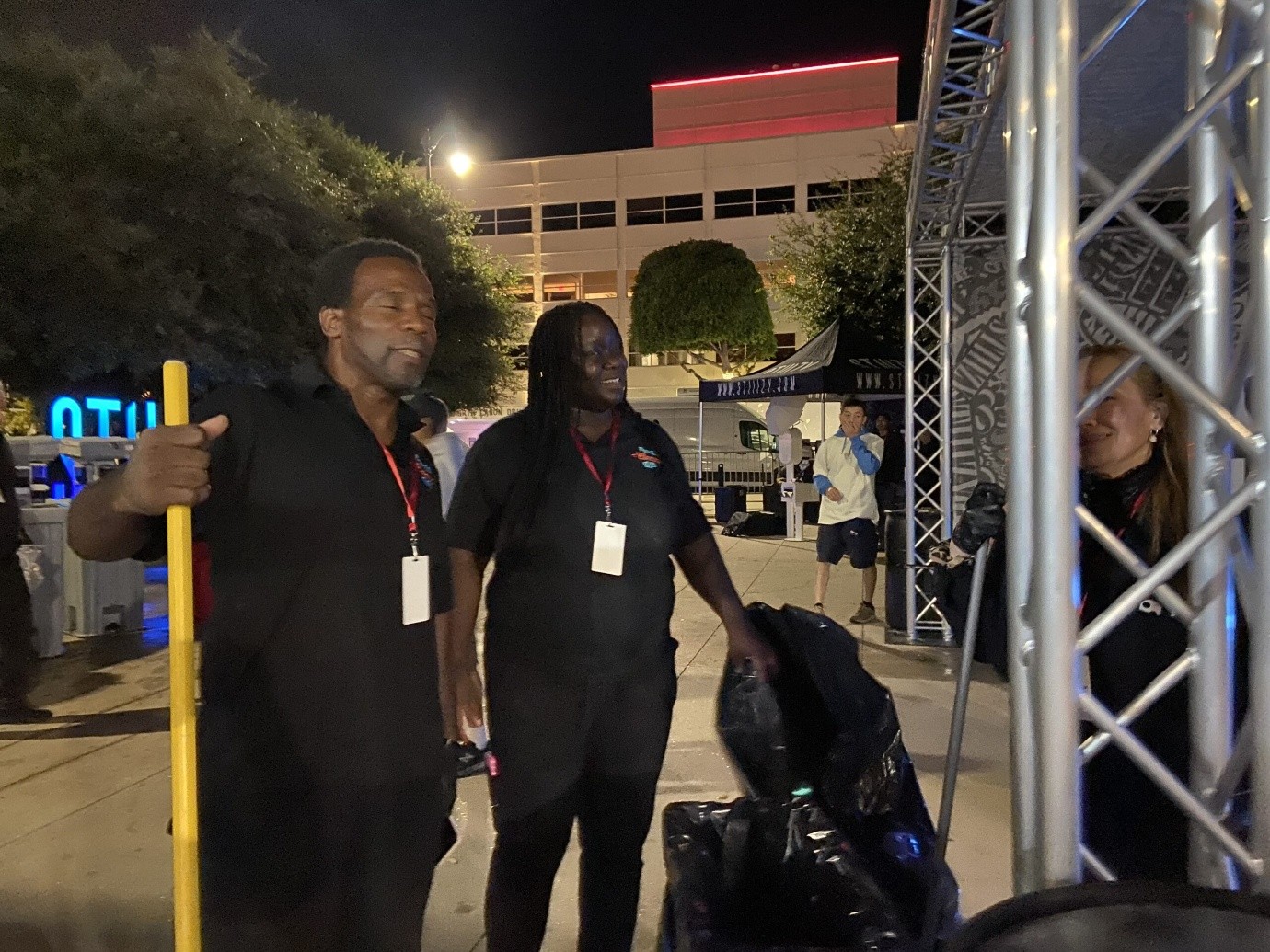
This festival we served was beautifully put together at a gorgeous architectural gem in Beverly Hills. We provided pre, live, and post event cleaning as well as oil recycling and trash hauling as well as wastewater removal.
This event production team was one of the best we have worked with in terms of preparation and disposition, but still we encountered challenges that are instructive going forward. The only food served at this particular festival were chicken tenders and some Hall Pass Ice Cream. There were about 12-14 chicken tender vendors, one ice cream cart, a stage with a DJ, and, of course, a full service bar.

Dumpster Placement
It was completely unclear from the aerial map provided that the dumpsters were located in a corner of the venue where the cleaners would have to go up and down several flights of stairs in order to discard the garbage bags. As we had provided a trash cart to prevent oil leakage from the bags onto the terracotta concrete that blanketed the venue, this meant that our crew members had to lift the trash cart filled with 10-20 bags and carry it down and up these stairs. This was both dangerous and exhausting. It was helpful to later learn that we could go around the property on the flat sidewalks but at that point, our staff had been going up and down those stairs for hours.
When you are mapping out your venue, always make sure that the dumpsters are readily accessible to the cleaning staff. Going up and down stairs, walking blocks away from the venue, or having to lift heavy bags over huge rolloff containers is inadvisable both from a time management standpoint and a labor standpoint. The more obstacles put in the way of the cleaners, the more time it will take them to do simple tasks and the slower their productivity.
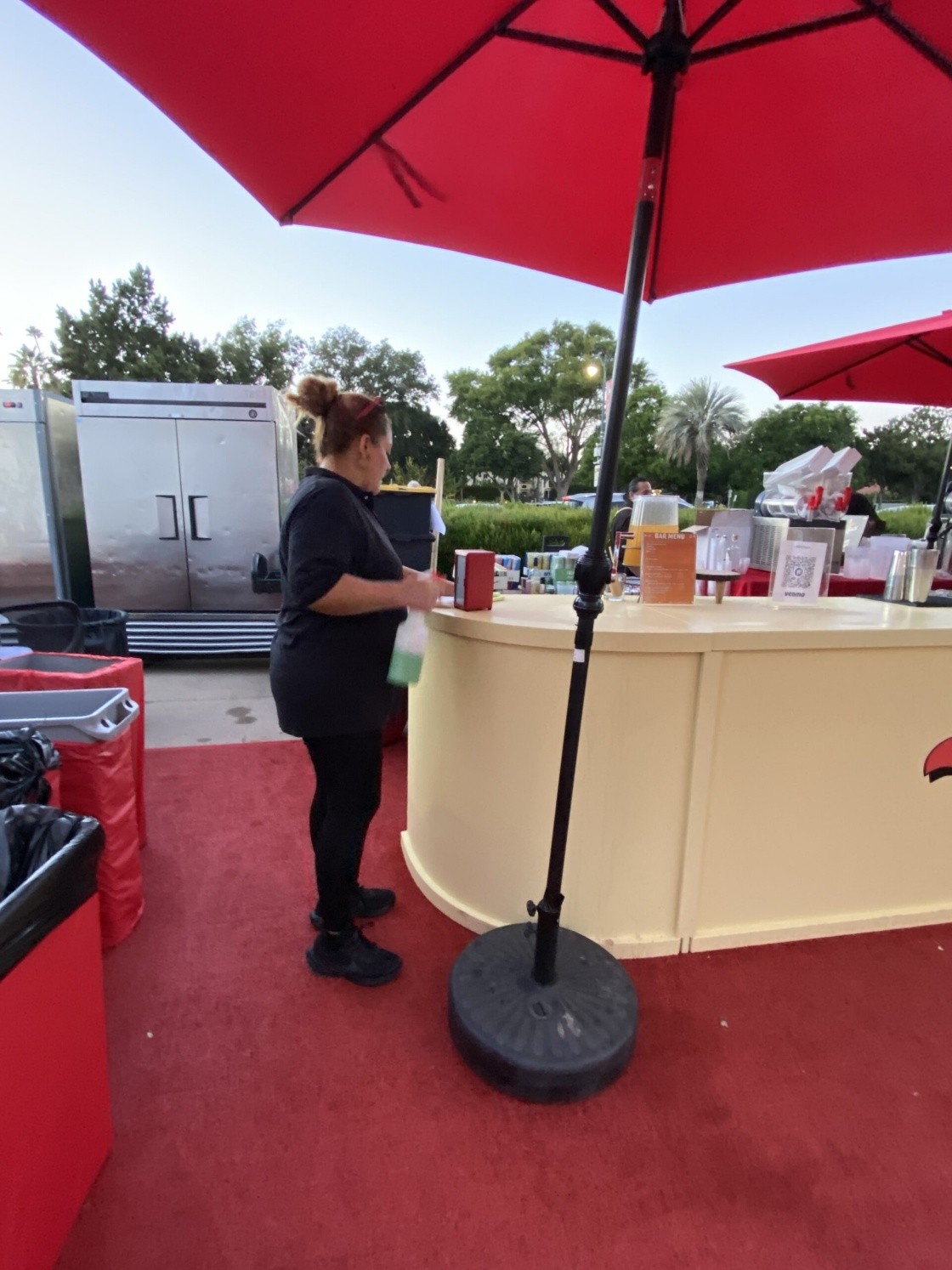
Along these lines, we also supplied 40 gallon cardboard trash boxes with liners, but the production team decided to go with wrapped 23 gallon Slim Jims instead to keep with the color scheme. While undoubtedly this looked much better and on brand, it also reduced the capacity of all of the trash cans by 17 gallons. As a result, the trash cans refilled at a much faster rate which made it harder for the cleaners to keep up with trash management, and meant that more trash bags would be used and the containers needed to be emptied more frequently. One solution to this is for your team to order the boxes ahead of time and spray paint them or order brute trash can rentals (which hold 35-50 gallons) instead.
Vendor Management
All of the chefs and their staff left their stations with trash all over the place, flour poured onto the red plastic carpets, and oil still in the fryers. Although removing trash from the vendor tents was part of our scope of work, it was not clear that we were expected to also clean up their individual stations. Normally when we work big fairs or festivals, each vendor is responsible for their footprint. This expanded our scope of work and extended our cleaning hours.
For the oil recycling, we supplied a C4 Portable Oil Recycling Barrel made of durable high density linear polyethylene with a capacity of 750 lbs (or approximately 100 gallons). The barrel had wheels to make it easy to roll around while empty. However, the oil needs to cool to under 150 degrees to be emptied into the barrel, and it cannot really be removed until the oil is completely cool the next day. Although PopUP CleanUP arranges for the oil recycling, for health and safety purposes, our staff does not empty the hot oil out of the fryers. They are not trained on this and are not covered to do so. This is a job for the chefs. We were told that all the chefs would bring containers to put the hot oil into after they were done and none of them actually did this. Instead, they left the oil in their containers for us to empty. On top of this, the oil container provided was based on the assumption of 12-14 fryers. However, there were 22 fryers on site, one of which had a broken valve, preventing the oil from being emptied. We did not have enough room for all of the oil in the C4 container but thankfully were able to store the excess in the chef’s metal tin containers. It took almost two hours to get the oil from the fryers into the Recycling Barrel, also extending our time and labor on site.
As far as the wastewater was concerned, we were told that we would only be emptying twelve (12) blue wastewater barrels that would be connected to both dishwashing and handwashing stations. It turns out that only three (3) of the blue barrels were full and that the handwashing stations had not been attached to many of the barrels and they needed to be emptied as well. The on site rental agents did not seem to be briefed on the wastewater removal because they knew nothing about this and many of the barrels and handwashing stations were not accessible to where the truck would be entering the venue. This is where asking a lot of questions prevented issues the next day, and why a preproduction meeting with all vendors and the production team is highly recommended.

Oil Spillage
When your food festival involves 22 fryers and lots of drinks and fried foods, oil spillage is inevitable. One of the major missions we were tasked with was trying to avoid staining of the terracotta tiles that lined the courtyard. The idea was to have our cleaners wipe up the spills in real time. However, only soap is going to cut grease, and the only way to remove it in real time is to scrub the areas with soap and then wash it away or power wash it away with water. This is not possible to do during a live event, particularly when people are wearing fancy clothes and shoes.
Also, because some of the trash cans had holes in them, when we lifted the cans at the end of the night, there were huge oil stains underneath them. Our team saw guests spilling food and drink throughout the venue, and some of the bags from the vendor tents dripped oil. Not all of this can be addressed or seen in real time. The only way to avoid oil stains is to cover the entire surface with an impermeable cover. Otherwise, a cleaning team should be scheduled for the next day once all the vendors have emptied out to scrub and power wash the ground and do one last sweep for trash when it’s light outside.
If you have a food festival you need complex logistics to sort out, PopUP CleanUP offers consulting and services to help make your event run smoothly and more sustainably.